
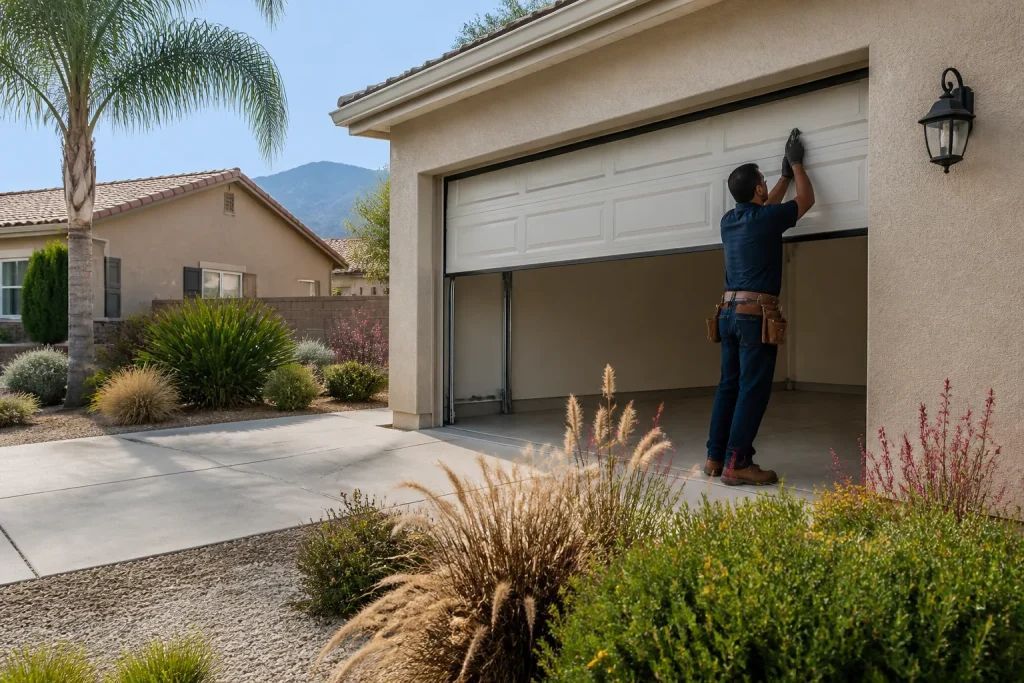
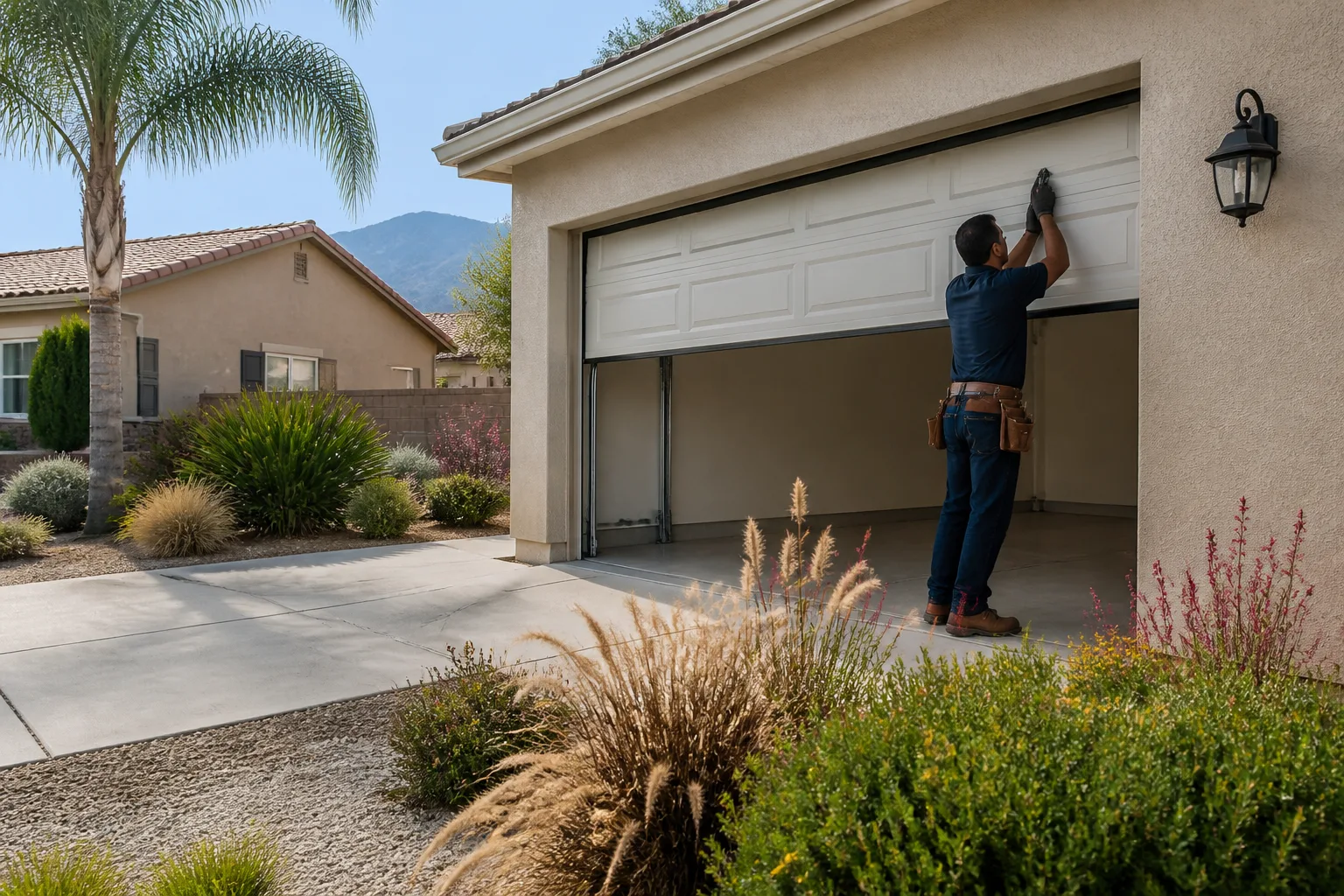
Genie Garage Door Repair in San Jacinto: A Homeowner’s Guide
Genie garage door repair in San Jacinto usually comes down to one of four things: an Intellicode board that’s lost its programming, a drive system that’s worn out, a sensor alignment issue, or a remote that won’t sync. Most of these are fixable the same day with brand-correct parts. If you’d rather not spend your Saturday wrestling with a ladder and a manual, call us at (866) 883-7857 and we’ll sort it out.
Genie has a loyal following in this part of Riverside County, and we understand why. The Intellicode rolling-code system does exactly what it promises: every time you press the remote, the code changes, so nobody can grab your signal and copy it. But that same security feature has a downside. Reset the board out of sequence, and the opener assumes it’s under attack and locks everything out, including your already-paired remotes. We get calls about this from San Jacinto homeowners every month.
Why Genie Openers Fail in San Jacinto More Than the Manual Suggests
The Genie manual covers basic maintenance and troubleshooting, but it doesn’t tell you what actually happens on the ground here. San Jacinto summers run hot, routinely over 100 degrees in July and August. Temps inside an uninsulated garage can climb 20 to 30 degrees higher than that. For a Genie opener with a plastic carriage and rail components, that heat does real work over time.
We regularly see hairline cracks in the carriage assembly on units five to eight years old, especially on homes along the Ramona Expressway corridor where garages face direct afternoon sun. The plastic gets brittle, then a normal open-close cycle snaps a tab or strips a gear tooth. The opener still hums, but the door doesn’t move. If you hear the motor running with no door movement, that’s often the carriage, not the motor.
Belt-drive Genie models hold up somewhat better in high heat than chain drives, simply because there’s less metal-on-metal friction generating additional warmth. Screw-drive Genies, like the older Excelerator line, run hot by design and tend to need more frequent lubrication in our climate. More on that below.
Genie vs. LiftMaster vs. Chamberlain: What San Jacinto Homeowners Should Know
We work on all three brands, plus Raynor, and they each have their own personality. If you’re deciding whether to repair your Genie or switch brands, here’s what we tell people in San Jacinto.
Genie’s Intellicode system is genuinely good security tech. It’s also proprietary, which means generic aftermarket remotes sometimes pair partially or fail entirely. LiftMaster and Chamberlain use Security+ 2.0, which has its own compatibility rules. None of these brands play well with universal remotes from big-box stores in every case.
The practical difference for San Jacinto homeowners:
- Genie: Excellent security, but board resets and remote pairing need to be done in exact sequence. The blue LED indicator patterns are your diagnostic friend.
- LiftMaster: Broad parts availability, including from third parties. Rock-solid longevity, but repair costs trend slightly higher for board replacements.
- Chamberlain: Shares LiftMaster’s parent company and most internal components. Smart-home integration is smoother out of the box.
If you already have a Genie mounted on your ceiling and it’s working, there’s no compelling reason to swap brands just because. The cost of a new opener plus install usually isn’t justified unless your unit is past its service life, which we cover below. If you do want a brand change, our Garage Door Opener Repair in San Jacinto page walks through what’s involved.
The Genie Intellicode Reset: Do It in the Right Order
Here’s the scenario we hear most often from San Jacinto callers: they bought a new Genie remote online, followed a YouTube video to program it, and now none of their remotes work. The old ones, the car’s built-in HomeLink, everything. What usually happened is the learn button was held too long or pressed twice, which clears all stored codes instead of adding one.
The correct sequence matters because Intellicode uses a shared rolling-code table. When you add a remote properly, the board increments the sequence and all paired devices stay in sync. When you clear and re-add only one remote, the others fall off the table and won’t rejoin until each is reprogrammed individually.
What to check before you reset anything:
- Watch the blue LED on the opener’s motor head. Steady blue means normal operation. Blinking blue in a pattern means a specific fault code. Two blinks, pause, repeat is usually a sensor issue, not a remote issue.
- Test the wall console. If the wall button opens and closes the door fine, the opener’s logic board and motor are working. The problem is in the radio receiver or remote pairing, not the drive system.
- Check the battery in the remote. Obvious, but we’ve diagnosed plenty of “dead openers” in San Jacinto that were just a $3 coin cell that baked in a hot car.
- Only after those steps, do a full Intellicode reset: hold the learn button until the blue LED goes out, then release. Reprogram the wall console first, then each remote in turn.
Skip a step and you can create a new problem on top of the old one. We pulled a Genie out of a garage over in Chapman Heights last month where the homeowner had cleared the board three times trying to add a single remote. By the time we arrived, the opener had locked itself into a security hold and wouldn’t accept any programming until we power-cycled the unit and reset the receiver module.
Genie Drive Systems: Chain, Belt, or Screw?
Genie has produced all three drive types across its Genie brand lineup. Knowing which one is mounted on your ceiling changes the repair math.
Chain drive is the classic Genie workhorse. Noisy but durable. The chain stretches over time, which makes the door run rough and can trip the force-sensing overload. In San Jacinto’s dry heat, chain lubrication also breaks down faster. If your chain drive Genie is clattering, a new chain and sprocket assembly often quiets it down like new.
Belt drive is the quiet option we recommend most often in San Jacinto, especially for homes where the garage sits under a bedroom. Genie’s belt drives use a reinforced rubber belt that doesn’t stretch the way chains do. The failure point is usually the belt itself showing cracks after years of heat exposure.
Screw drive is less common in newer Genie models but we still see plenty of them in San Jacinto homes built in the 1990s and early 2000s. The screw is a long threaded rod that turns to move the carriage. In high heat, the grease on that screw gets gummy. The fix is usually a thorough cleaning and fresh lithium grease, not a new opener. Screw drives are also slower, which some people notice as a sluggish open feel.
For complete Garage Door Repair in San Jacinto, we’ll inspect your entire door system, not just the opener. A misaligned track or failing spring puts extra load on any Genie drive and shortens its life.
Aftermarket vs. OEM Parts for Genie Openers: What to Use Where
This is where Genie owners in San Jacinto often get steered wrong. The big-box store sells a universal replacement gear or carriage that claims to fit “all Genie models.” It doesn’t. Genie has used several distinct carriage designs over the years, and a universal part that’s close but not exact will chew itself up within months.
Our rule of thumb:
- Use OEM Genie parts for: Intellicode receiver boards, carriages, drive gears, and safety sensor pairs. These components are engineered to specific tolerances and the aftermarket versions we’ve tested fail early.
- Aftermarket is usually fine for: remote batteries, wall console cosmetic parts, and certain tension springs. These are commodity components where brand doesn’t affect function.
The reason OEM matters for the Intellicode board specifically is the radio frequency calibration. Genie boards are tuned at the factory. Some aftermarket receiver modules drift off frequency in heat, which means your remote only works when you’re 10 feet from the door instead of across the street. We’ve seen that exact complaint from homeowners near San Jacinto High School, where summer garage temps push aftermarket electronics past their comfort zone.
When to Repair a Genie vs. Replace It
The decision isn’t just about the repair bill. It’s about what else is likely to fail next.
Here’s the math we walk through with San Jacinto homeowners:
- Under 5 years old: Repair almost always makes sense. The motor and board have plenty of life. Even a $200 board replacement is cheaper than a new unit plus install.
- 5 to 10 years old: Depends on the failure. A broken carriage or stripped gear on a healthy motor? Repair the Genie. But if the board is failing AND the drive system is worn, replacement starts to look smarter.
- Over 10 years old: Genie openers in San Jacinto’s heat rarely make it past 12 to 15 years without major work. If you’re at this age and looking at a $300-plus repair, a new opener is often the better call. You get fresh electronics, new safety sensors, and a warranty.
A working Genie door is a security barrier as much as it is a convenience fixture. A half-dead opener that occasionally reverses or doesn’t close fully isn’t just annoying, it’s an invitation. If you’re on the fence about repair versus replacement, check out our Garage Door Installation in San Jacinto page for what a new system actually involves.
Common Genie Fault Codes: What the Blinking Lights Mean
Genie openers communicate through LED patterns, and San Jacinto homeowners can use these to pinpoint the problem before picking up the phone. Here are the patterns we get asked about most:
- Blue LED, steady: Normal. The opener is powered and waiting for a command.
- Blue LED, one blink, repeat: The opener hit its force limit. Usually a spring tension issue or an obstruction on the track. This is the one that means a broken torsion spring more often than not.
- Blue LED, two blinks, repeat: Safety sensor beam blocked or misaligned. Check for spider webs, direct sunlight hitting the lens, or a shifted bracket.
- Blue LED, three blinks, repeat: Control board overheat. In San Jacinto, this sometimes happens on 110-plus degree days when the opener has been cycled repeatedly. Let it cool down for 30 minutes and try again.
These patterns save time, but only if you read them correctly. A two-blink pattern gets misdiagnosed as a bad board all the time when really it’s just a sun-warped sensor bracket. If the diagnosis isn’t straightforward, that’s the point where calling a garage door specialist makes sense. We’d rather spend five minutes walking you through a LED reading over the phone than sell you a board you don’t need.
When to Call a Pro
Some Genie repairs are genuinely DIY-friendly: swapping remote batteries, tightening a loose chain, cleaning sensor lenses. If you’re comfortable with a step ladder and basic hand tools, those are fine to tackle.
Other situations call for a trained professional, and this isn’t us being protective of our trade, it’s about safety and not making the problem worse. The section above lists some thresholds. Here’s when we’d say stop and call:
- Any electrical issue beyond unplugging the unit. Openers run on household current. A board replacement or wiring repair done wrong can start a fire or fry the new board.
- A broken spring attached to the door. Garage door springs hold enormous tension. When they snap, they release that energy in an instant. This is dangerous work that should never be DIY’d. The opener force settings also need recalibration after spring work on most Genie models.
- Multiple remotes that won’t pair after a reset. If you’ve followed the proper Intellicode sequence and still can’t get everything synced, there’s likely a receiver board issue that needs diagnosis.
- A garage door opener that’s fallen off its mounting bracket. This is a two-person, specific-torque job. A dropped opener lands on whatever is below it.
If you’re not sure which category your situation falls into, call us. We’ll help you figure it out over the phone before anyone books a truck. We don’t send a technician to your door in San Jacinto unless there’s actually something to fix. Full Osprey Garage Door Repair home details live on our homepage.
The Bottom Line
Genie openers are worth repairing in most cases, but only with the right parts, the right sequence, and an honest assessment of how much life the unit has left. The Intellicode system is a security asset, not a liability, as long as resets are done in order. Heat is the biggest invisible enemy for Genie components in San Jacinto, and it’s predictable: plastic carriages get brittle, grease dries out, and aftermarket electronics drift off frequency.
If you’re in San Jacinto and need help with a Genie opener, Osprey Garage Door Repair offers free estimates and same-day service for most repairs. We work on the brand you already have. Call (866) 883-7857 and we’ll get it diagnosed fast and fixed right.
Frequently Asked Questions
Most Genie repairs in San Jacinto run between $120 and $325 depending on the part. A replacement Intellicode board typically falls at the higher end, while sensor realignment, chain tensioning, and remote programming sit at the lower end. We quote the price and get your approval before any work starts, so the number you hear on the phone is the number you pay. Call (866) 883-7857 for an exact quote.
Yes, in most cases. If the repair involves a part we carry on the truck, which covers common Genie failures like sensors, remotes, and carriage assemblies, we can often complete the job the same day we’re called. If the part needs to be ordered, we’ll tell you that upfront and get it in as quickly as possible. Call (866) 883-7857 and we’ll let you know what’s realistic for your specific Genie model.
You likely cleared the Intellicode memory instead of adding a device. The learn button does two different things depending on how long you hold it. A short press adds a device. A long hold clears all paired remotes. Fixing this means reprogramming the wall console first, then each remote individually in the right sequence. If the board has entered a security hold, you may need a technician to power-cycle and reset the receiver module.
At 12 years old in San Jacinto’s heat, replacement usually makes better financial sense than a major repair. A new opener gives you fresh electronics, new safety sensors, a warranty, and better energy efficiency. If the repair is minor, like a sensor or remote issue, repair makes sense. If the board and the drive system are both showing age, put your money toward a new unit. We’ll give you an honest recommendation either way.
Written by the team at Osprey Garage Door Repair, serving San Jacinto since 2011.
Need Garage Door Help?
Call Osprey Garage Door Repair - licensed & insured, here with fast help in San Jacinto.
(866) 883-7857